




Learning by looking: Ontario Tech researcher’s app design turns everyday objects into vocabulary tools


Learning a new language at any age can be an incredible difficult process, one that requires significant effort, time and dedication. But a researcher at Ontario Tech University has developed an educational online tool that uses advanced technology to make the learning journey fast, effective, and even fun.
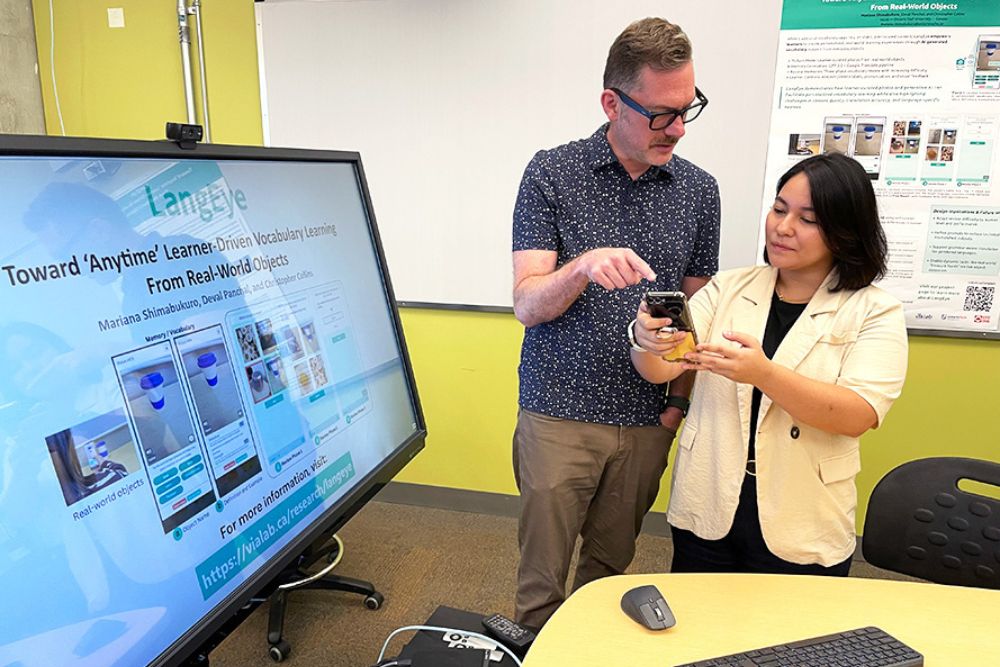
Dr. Mariana Shimabukuro is the creator of LangEye, a tool that helps people learn new words in a foreign language by connecting them with real-life objects. Instead of just memorizing vocabulary from a textbook, LangEye smartphone app users take pictures of things around them (like a chair, a cup, or a tree), and the app helps turn those photos into learning tools.
“The app uses artificial intelligence (AI) image recognition and language to identify the object in the photo, show the word in the target language, and then provide the definition, an example sentence, and how to pronounce it,” says Dr. Shimabukuro, an Associate Teaching Professor with Ontario Tech’s Faculty of Science. “LangEye also helps users review what they’ve learned by moving from recognizing images to recalling words without help, making the learning more active and long-lasting.”
Dr. Shimabukuro recently presented her preliminary LangEye research work at a major international computational linguistics conference in Austria.
What did the LangEye study find?
“We tested the app in a small study with people learning French,” says Dr. Shimabukuro. "Some users took their own photos, while others used AI-generated images of the same items. Everyone found LangEye easy to use, and people who used their own photos felt more connected to what they were learning, saying it was more fun and meaningful. More research is needed to understand how well it helps people remember words long-term.”
- Learn more about the app on the LangEye project website
- LangEye video link
Future research developments
LangEye is one of several projects Dr. Shimabukuro’s research group is working on to explore how AI can help create better educational content, improve assessments, and support more-personalized learning. As AI makes it easier to tailor learning to individual students, it's important that educators (teachers, instructors and facilitators) fully understand how these tools work, so they feel confident using them in the classroom.
”Many educators are excited about the potential of AI, but most of today’s tools don’t quite meet their teaching goals or align with ethical standards set by schools and institutions,” says Dr. Shimabukuro. “Even though there are still big questions about the long-term impact of AI on critical thinking, we see an opportunity. With our background in Human-Computer Interaction (HCI) and applied AI, we’re working to design the next wave of educational tools. These tools aren’t meant to replace teachers, but to support and enhance what they do. The tools will be teacher-guided, focused on students’ needs, and flexible enough for classroom use and as well as independent learning.”
Background
LangEye was developed as part of Dr. Shimabukuro’s PhD (2024) dissertation research at Ontario Tech (titled ‘Promoting autonomy for language learning powered by data-driven methods and learner-centred design’), under the supervision of the Faculty of Science’s Dr. Christopher Collins. Contributors included Ontario Tech alumni Deval Panchal (Computer Science, class of 2024, now a software engineer at Ontario Power Generation), who implemented the app as a research assistant and leading developer; and Shawn Yama (Computer Science class of 2022, now a software engineer at Uncharted Software in Toronto), who worked on the early user interface/user experience design of the application.
Media contact
Communications and Marketing
Ontario Tech University
communications@ontariotechu.ca
Latest Faculty of Science
- A university on the rise: Ontario Tech’s growth reflected in Maclean's 2027 rankingsOntario Tech University’s continued growth, expanding research activity and strong student services results are highlighted in the latest Maclean’s University Rankings.
- Ontario Tech to celebrate a new chapter for graduates at Fall ConvocationOn Thursday, October 15, Ontario Tech University will proudly recognize the accomplishments of the Class of 2026 during Fall Convocation.
- Tech with a conscience: Why purpose and responsibility matter more than everOntario Tech University's approach to technology is rooted in a long-standing, human-centred institutional philosophy known as tech with a conscience: a belief that technology is most powerful when it serves people, with human purpose, responsibility and judgment at the core.
- Meet Ontario Tech University's 2026-2027 major scholarship recipientsEach year, Ontario Tech University recognizes seven exceptional incoming students with its most prestigious entrance scholarships. Awarded to students who have demonstrated outstanding achievement in academics, leadership and community involvement, these scholarships celebrate the passion, dedication and potential that students have shown throughout their high school journey.
- Ontario Tech students to benefit from $91.9-million provincial investmentA $91.9-million investment from the Ontario government will help Ontario Tech University expand capacity in programs aligned with regional and provincial labour-market needs, creating more opportunities for students to pursue career-connected learning in high-demand fields.
- Ontario Tech sees record demand from Ontario high school students, with confirmations up 49.7 per cent since 2021Ontario Tech University continues to see strong demand from Ontario high school students, with confirmed first-year enrolments for 2026-2027 reaching a record high. This achievement reinforces the university’s role in preparing graduates for rapidly evolving industries across all sectors.