




From the dinner table to the national stage: Salma Bafagih on research, resilience and food literacy


When Salma Bafagih talks about food, she doesn’t just mean what’s on the plate. She’s thinking about culture, community, health and the systems that shape how Canadians make everyday food choices.
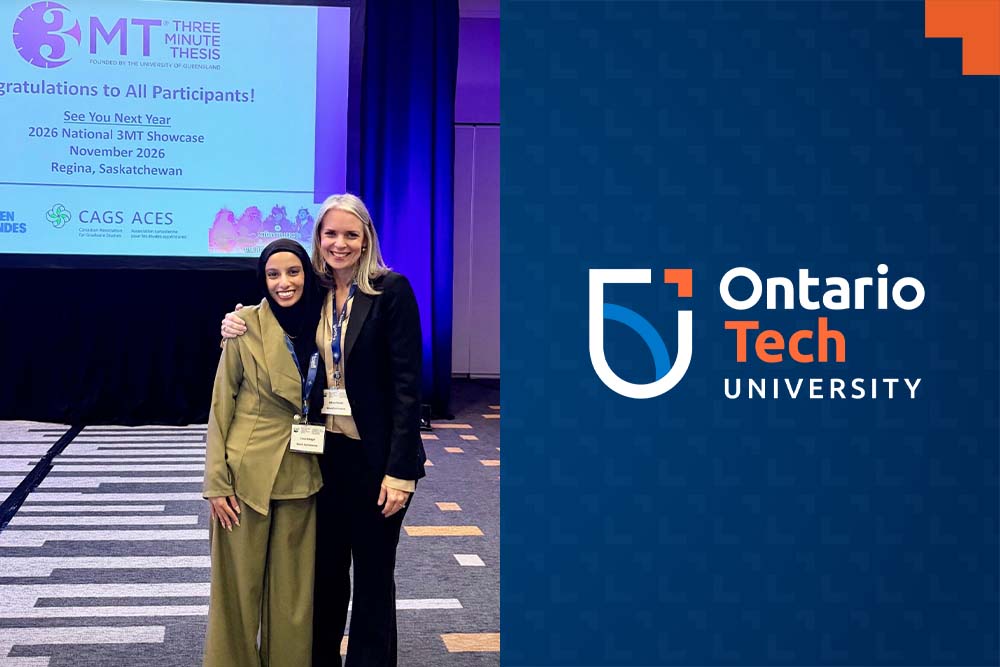
A master’s student in the Faculty of Health Sciences (FHSc) at Ontario Tech University, Bafagih brought her research on food literacy to national audiences through the Three Minute Thesis (3MT®) competition. Her presentation, What’s on your plate? Examining predictors of food literacy among Canadian adults, earned first place at Ontario Tech’s 3MT® competition in 2025 and a second-place finish at the provincial level. Recently, she went on to present at the 2025 National 3MT® Showcase in Ottawa during the Canadian Association for Graduate Studies Conference.
Her research journey, however, began much closer to home.
“I come from a culture that loves food,” Bafagih says. “The entire cooking process is something that is so important to me and my family.”
Her lived experience, combined with years of volunteering, sparked her interest in public health and nutrition. She saw firsthand how often families struggled to navigate grocery stores, adapt cultural recipes, or manage chronic conditions through diet.
These observations became the foundation of her master’s research, conducted under the supervision of Dr. JoAnne Arcand, Associate Professor in the FHSc. Bafagih’s work explores food literacy—the knowledge, skills and practices that influence food choices—and how it is shaped not only by individuals but also by broader social, industry and policy factors.
“I was shocked to discover just how under-researched food literacy is in Canada,” Bafagih says, adding that other countries, like Australia, have invested heavily in this area of research. “I recognize my research is a small but crucial step in the right direction.”
A commitment to real-world impact defines Bafagih’s experience at Ontario Tech. Through her studies and lab work, she has developed practical skills beyond the classroom including critical thinking, collaboration, adaptability and confidence.
Her time in Dr. Arcand’s lab was filled with mentorship and teamwork, with regular meetings that encouraged open feedback, shared learning and peer support. This supportive environment ultimately gave her the confidence to participate in the 3MT® competition, a challenge she initially found intimidating.
“I would not have participated in the 3MT® competitions if it wasn’t for the support of faculty and peers,” she said. “They motivated me to take risks and put my all into my 3MT®.”
Condensing nearly a year of research into a three-minute presentation pushed Bafagih to rethink how she communicates complex ideas. The experience strengthened her ability to explain her work clearly and authentically. Presenting at the national showcase in Ottawa further expanded her perspective on scholarly communication and networking. Surrounded by graduate students from across the country, Bafagih saw how creative and impactful research storytelling can be, and how genuine conversations can turn into meaningful professional connections.
Looking ahead, she sees her work as a foundation for future innovation and policy change, particularly for underserved and under-researched populations.
“When I see statistics representing these groups, I don’t see it as just a number,” she says. “I see people in my community. I genuinely hope that my research can inform future work so that we can ultimately support people and make healthy eating accessible.”
For Bafagih, the recognition she’s received is both affirming and motivating.
“I’ve come to realize that the only person holding me back from trying new and intimidating things is myself,” she says. “This recognition is not just a reminder of how far I’ve come; it inspires me to believe in how much further I can go.”
Ontario Tech’s 2026 3MT® competition is just around the corner, with heats on Wednesday, March 18 and finals on Thursday, March 19. It’s a great opportunity to see the creativity and impact of graduate research in action.
Learn more about this year’s event on the 3MT® website.
2 > 1
Latest Faculty of Health Sciences
- Harnessing AI and virtual reality to help memories come aliveOntario Tech University researcher Dr. Winnie Sun is exploring how artificial intelligence, virtual reality and multisensory technology can help make memorable moments more accessible and easier for people living with dementia to share with loved ones.
- A university on the rise: Ontario Tech’s growth reflected in Maclean's 2027 rankingsOntario Tech University’s continued growth, expanding research activity and strong student services results are highlighted in the latest Maclean’s University Rankings.
- Ontario Tech to celebrate a new chapter for graduates at Fall ConvocationOn Thursday, October 15, Ontario Tech University will proudly recognize the accomplishments of the Class of 2026 during Fall Convocation.
- Tech with a conscience: Why purpose and responsibility matter more than everOntario Tech University's approach to technology is rooted in a long-standing, human-centred institutional philosophy known as tech with a conscience: a belief that technology is most powerful when it serves people, with human purpose, responsibility and judgment at the core.
- Ontario Tech University researchers highlight the long-term health impacts of wildfire smokeWildfire smoke has become an increasingly familiar part of Canadian summers, affecting communities thousands of kilometres from the fires themselves. While hazy skies and poor air quality are often temporary, Ontario Tech University researchers are examining how some health effects can persist long after the smoke clears.
- Penalty kicks, pressure and performance: The psychology of elite sportDr. Bryan McLaughlin, a postdoctoral fellow in Ontario Tech University’s Faculty of Health Sciences, shares his thoughts about the psychology behind elite performance, why some athletes thrive under pressure, and what lessons from sport psychology can be applied beyond the playing field.