




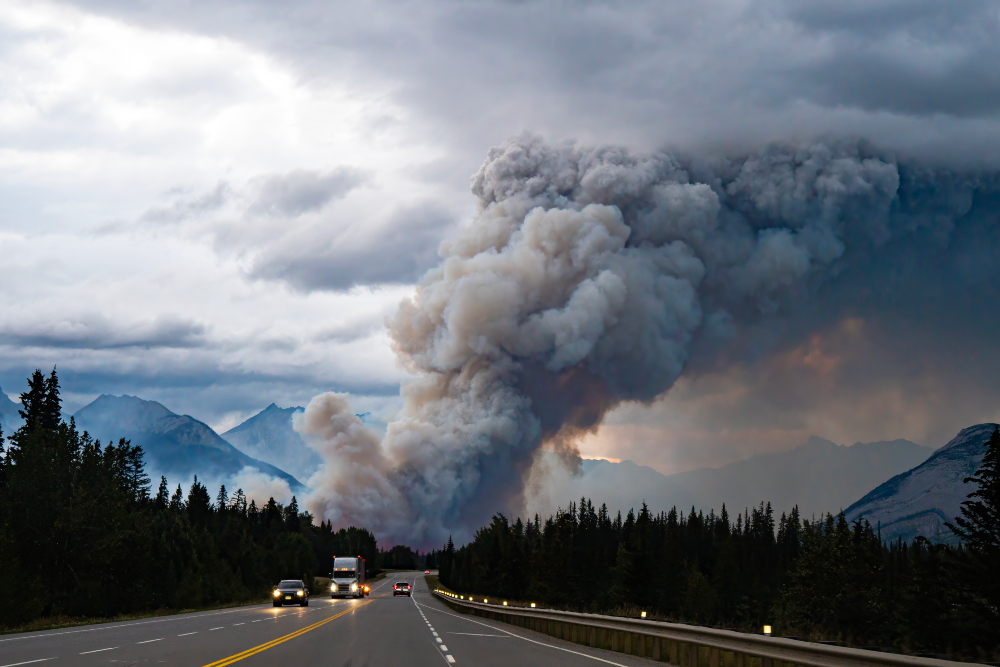
Wildfire smoke has become an increasingly familiar part of Canadian summers, affecting communities thousands of kilometres from the fires themselves. While hazy skies and poor air quality are often temporary, Ontario Tech University researchers are examining how some health effects can persist long after the smoke clears.
Smoke affects more than the lungs
Much of the concern centres on PM2.5, the fine particulate matter found in wildfire smoke. These tiny particles can travel deep into the lungs and enter the bloodstream, contributing to inflammation throughout the body.
Dr. Caroline Barakat, Professor, Faculty of Health Sciences (FHSc), investigates how environmental exposures influence health over a lifetime. She notes that researchers now recognize wildfire smoke as more than a short-term respiratory irritant. Growing evidence suggests repeated exposure may be linked to heart disease, stroke, adverse pregnancy outcomes, cognitive decline and psychological distress.
Dr. Barakat's research has found that children exposed to higher levels of fine-particulate air pollution were more likely to develop chronic inflammatory conditions such as hypertension and arthritis later in adulthood.
"These findings reinforce an important concept in environmental health," she says. "The effects of air pollution are not always immediate, and early-life exposures can shape health decades later."
Why some people feel the effects more strongly
Although wildfire smoke can affect anyone, the impacts are often more severe for people living with chronic respiratory conditions.
Dr. Mika Nonoyama, Associate Professor, FHSc and a Registered Respiratory Therapist, studies respiratory disease management and how environmental conditions affect people living with chronic lung disease. She explains that temporary symptoms experienced by healthy individuals during periods of heavy smoke, such as throat irritation, burning eyes, coughing or mild shortness of breath, typically improve when exposure decreases.
But for people with asthma, chronic obstructive pulmonary disease (COPD) and other respiratory illnesses, the effects can be more significant because their airways are already inflamed or damaged. "Wildfire smoke can exacerbate airway inflammation and increase their symptoms,” she says.
These flare-ups can reduce exercise tolerance, interfere with daily activities, increase the need for rescue medications, and in some cases lead to emergency department visits and hospitalizations.
"It’s important for everyone to be aware of their own baseline health status," says Dr. Nonoyama. Persistently worsening symptoms or a noticeable decline in the ability to carry out normal activities may signal the need for closer monitoring or consultation with a health-care provider.
Not everyone faces the same level of risk
"Wildfire smoke is very much a health-equity issue," says Dr. Barakat.
Children, older adults, pregnant individuals and people with underlying heart or lung conditions are among those most susceptible to smoke-related health impacts. But social and economic factors can also influence risk.
Lower-income households, people experiencing homelessness, outdoor workers and those without access to clean indoor air may be disproportionately affected. Indigenous communities can face additional challenges, particularly in regions experiencing repeated smoke events, evacuations and disruptions to essential services and community life.
These factors underscore why wildfire smoke is an important public-health consideration. "We need policies and investments that ensure equitable access to clean air, timely information, and the resources needed to reduce exposure and mitigate the related health effects ,” she says.
Preparing for future smoke events
Dr. Nonoyama recommends monitoring the Air Quality Health Index, reducing outdoor activity when air quality is poor, and creating cleaner indoor environments by using high-efficiency particulate air (HEPA) filtration where possible.
For those living with asthma or COPD, having an up-to-date action plan and an adequate supply of medications before wildfire season begins can help reduce risks.
In addition, people should not rely solely on what they can see outside. "Wildfire smoke can be harmful even when visibility appears acceptable," she says.
Dr. Barakat highlights that wildfire smoke is part of a broader set of interconnected challenges related to climate change, environmental conditions, infrastructure and health inequities.
“Addressing these challenges requires interdisciplinary research, public education, and stronger collaboration between public health, environmental scientists, governments and communities,” she says.
Ready for tomorrow’s careers.
We prepare our students for the fast-paced, ever-evolving world of technology.