





Artificial intelligence (AI) is increasingly positioned as a tool to support climate action, from improving weather forcasting to strengthening agricultural monitoring. At the same time, its rapid growth raises important questions about energy demand, water use and equitable access to the technology’s benefits.
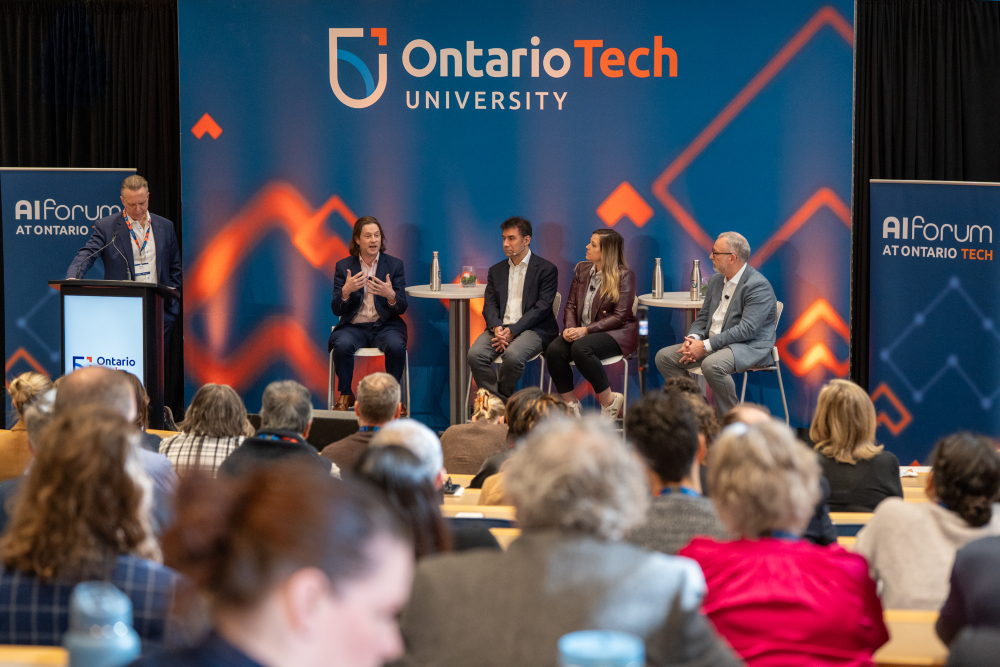
These tensions were the focus of AI and Climate Change: The Good, the Bad and the Uncertain, a panel discussion hosted by Ontario Tech University’s Faculty of Social Science and Humanities, Office of Campus Infrastructure and Sustainability, and the recently launched Mindful AI Research Institute (MAIRI), as part of the university’s annual Critical Climate Week. It took place against the backdrop of COP30, the United Nations Climate Change Conference underway in Amazonia (Belém, Brazil) at the same time.
Understanding the hidden environmental costs of AI
As climate change intensifies heatwaves, alters rainfall patterns and increases water scarcity, communities worldwide are facing mounting environmental pressures, particularly those with fewer resources to adapt.
“Against this backdrop, humanity, almost exclusively the global north, is building potentially some of the most energy- and water-consuming technology we’ve ever conceived: modern artificial intelligence,” said Dr. Peter Lewis, Canada Research Chair in Trustworthy Artificial Intelligence, Associate Professor in Ontario Tech’s Faculty of Business and Information Technology (FBIT) and MAIRI Director.
Panelists emphasized that awareness of AI’s environmental footprint does not automatically translate into behaviour change. Dr. Hannah Kerner, Assistant Professor, School of Computing and Augmented Intelligence, Arizona State University, noted that her students are often surprised when they learn about the resources required to operate widely used AI tools like ChatGPT. Yet most of them continue using the technology, much like the consumers who understand impacts of fast fashion or industrial food systems but still participate in those markets.
To drive more responsible use, Dr. Theresa Miedema, Associate Teaching Professor, FBIT, proposed that a clearer disclosure of AI’s environmental impacts be incorporated into sustainability reporting and institutional decision-making, alongside broader policy and regulatory approaches.
Equity, access and global responsibility
Panelists also addressed the equity implications of AI deployment in climate-related contexts, highlighting the risk of digital colonialism: the introduction of technological solutions developed without local input.
Dr. Merlin Chatwin, Ontario Tech Post-doctoral Fellow in the Faculty of Social Science and Humanities and Executive Director, Open North, emphasized the importance of incorporating Indigenous knowledge, strengthening digital public infrastructure and directing climate-related investments toward regions most vulnerable to environmental change.
“Although there are tangible uses of AI in climate action, we need to ensure its use doesn’t intensify existing inequalities or further marginalize vulnerable populations,” he said.
Where AI shows promise, guided by human insight
Despite these challenges, panelists agreed that AI’s potential lies in data-driven decision-making, enabling smarter climate strategies and more efficient use of resources.
“Climate change is a systems problem,” said Dr. Miedema. “Understanding a system is very difficult, and that’s an area where AI can really help.” She pointed to machine learning techniques that can model complex interactions in ecosystems, helping policymakers decide where to allocate resources for conservation, or which species to prioritize for protection.
Other examples discussed included AI-supported wildfire prediction, improved weather forecasting, and monitoring agricultural conditions across entire regions or globally.
“We try to work on problems you can’t realistically solve without AI,” explained Dr. Kerner.
For example, her work with the NASA Harvest and NASA Acres programs uses AI to monitor crop health and assess the effects of disasters and conflict on food production. This research depends on global field-boundary data gathered through projects like Fields of the World, which aims to map every agricultural field worldwide. That kind of data is impossible to collect manually, but it’s now achievable through AI models trained on satellite data. The insights from this research support policies like the European Union’s deforestation regulations that incentivize sustainable supply chains, and help communities adapt to changing conditions.
Moving beyond good or bad: Rethinking our priorities
Rather than framing AI as inherently beneficial or harmful, Dr. Miedema encouraged a broader conversation about the values shaping technological development and consumption.
“There’s so much buzz about whether AI is good or bad for climate change, and I think that’s the wrong question,” she said. “I've got a news flash: It is not AI. It's us; it's our over-consumption, our addiction to stuff, our ability to consume and impose the costs on other people. It's our need for dopamine hits, and the over-valorization of efficiency.”
She maintained that addressing climate change will require reimagining those values and priorities, and applying technology in ways that support more sustainable and equitable forms of human flourishing.
Ready for tomorrow’s careers.
We prepare our students for the fast-paced, ever-evolving world of technology.